
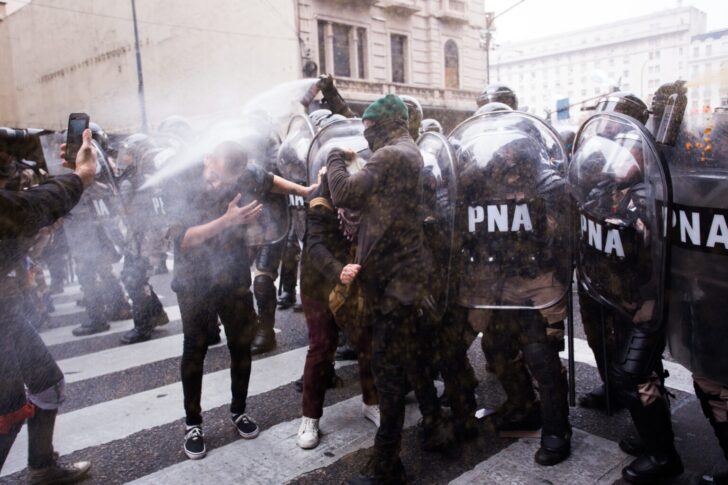
The State was called before the IACHR to address the deterioration of freedom of expression and of the press in Argentina. It minimized the concerns, describing the incidents presented as isolated and declining to respond to the marked increase in attacks on journalists, photographers, and demonstrators over the past two years.
Amnesty International, the Buenos Aires Press Union (SiPreBA), the Federation of Press Workers (Fatpren), FOPEA, ARGra, and CELS participated in the hearing in Miami, alongside journalists Julia Mengolini and Hugo Alconada Mon and photographer Tomás Cuesta. They described the attacks they have experienced since Javier Milei took office.
Their testimonies outlined a broader pattern: attacks on critical voices, harassment of the press, and the use of criminal law and surveillance tools to curb dissent; the dismantling of public media and the lack of support for community outlets; and the dangerous conditions faced by media workers covering protests. They also highlighted the heightened risks for people demonstrating in public spaces following the government’s “anti-picketing” protocol and repressive police operations—all amid increased monitoring and control of public opinion, as evidenced by the recent publication of excerpts from the National Intelligence Plan.
The role of authorities
During the hearing, Undersecretary for Human Rights Alberto Baños denied that freedom of expression is under threat. He argued that individual attacks cannot be linked to State policy and downplayed the fact that many online attacks have been carried out by the President himself. He also dismissed the testimonies presented as irrelevant.
In response, IACHR Executive Secretary Tania Reneaum Panszi noted that the Commission was not observing isolated cases but a pattern of concern. “Everything suggests a context of threats and criminalization of journalists and human rights defenders,” she said.
Pedro Vaca, the IACHR Special Rapporteur for Freedom of Expression, underscored the power imbalance inherent in official speech. “When a public authority addresses the press, they speak from a position of power, and that has consequences. An official’s voice is not just any voice. The inter-American system expects public authorities to avoid generating risks for others,” he explained.
The Commission acknowledged the essential role of the press in reconstructing repressive police operations and identifying those responsible. As we reported during the hearing, “Nearly 3,000 people were injured in protests in 2024 and 2025. Almost 300 were media workers. In 2025 alone, attacks on journalists have already doubled those recorded in 2024.”
Our requests
We urged the IACHR to monitor the escalating repression in Argentina and to call on the government to take concrete steps to stop attacks against journalists and critical voices. We also asked for measures to end the repression of demonstrators and of those who cover protests.
Finally, we requested an in-country visit by the Commission together with the Office of the Special Rapporteur for Freedom of Expression.
The request for the hearing was submitted jointly with AMARC, Fundación Transparencia Activa, Innocence Project Argentina, the Communication Sciences Program at the University of Buenos Aires, REDCOM (the Network of Communication Programs), Colectivo Revista Crisis, and the Heinrich Böll Foundation.