
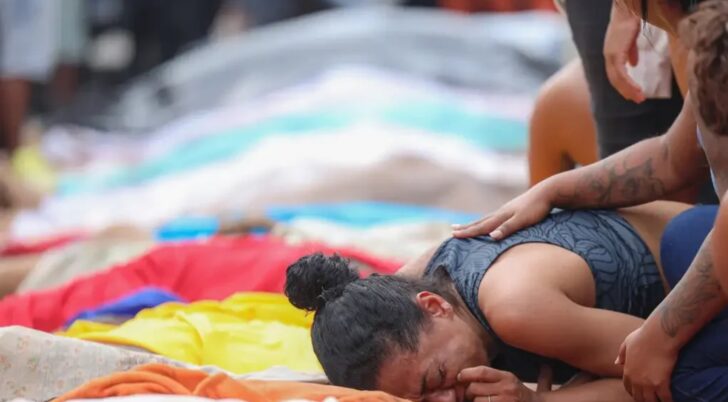
The massacre on the night of October 28 in the Alemão and Penha favela complexes in northern Rio de Janeiro is part of a long and tragic history of killings committed by state police forces under the guise of public policy. So far, 64* people have been killed in a single operation, the deadliest in the history of Rio de Janeiro.
The massive loss of life reiterates the pattern of lethality that characterizes the government of Cláudio Castro, governor of Rio de Janeiro, responsible for four of the five deadliest operations in history. He has surpassed his own records, set in Jacarezinho (2021) and Vila Cruzeiro (2022). What Governor Cláudio Castro described today as the largest operation in the history of Rio de Janeiro is, in reality, a massacre perpetrated by the Brazilian state.
During the nearly 40 years that the Federal Constitution has been in force, what we have seen in the favelas of Rio de Janeiro is the consolidation of a security policy based on the use of force and death, disguised as “war” or “resistance to crime.” This is a selective approach, directed against black and impoverished populations, which uses bloodshed as an instrument of control and domination.
No element in this policy effectively reduces the power of criminal factions on the ground. On the contrary, these actions deepen insecurity and fear, sow panic, disrupt the daily lives of thousands of families, prevent children from attending school, and impose terror as an expression of state power. Death cannot be considered public policy.
This cycle of violence is not accidental: it stems from a deliberate strategy that prioritizes armed confrontation over any commitment to life and the rule of law. During his speech, the governor attempted to blame the lethality of the operation on Fundamental Precept No. 635—the Federal Supreme Court decision that establishes rules and limits for police operations in the favelas—and on the civil society organizations that worked to implement it. In doing so, he attacks the control of police activity, a function constitutionally assigned to the Public Prosecutor’s Office, and seeks to delegitimize the work of organizations fighting for the right to life in the favelas.
Castro also took political action to undermine the Federal Supreme Court’s decision, with the aim of freeing security forces from legal obligations such as advance planning and the protection of lives. At the same time, he maintained the logic of rewarding lethality by sanctioning, in the new Organic Law of the Civil Police, a bonus for “bravery,” a provision that replaces the old “Far West bonus,” vetoed after widespread social condemnation. By rewarding confrontation and death, the government fosters a war mentality and transforms communities into battlefields, where residents are treated as “internal enemies.”
The Handbook on the Use of Force and Firearms by Law Enforcement Officials, published by the United Nations Office on Drugs and Crime (UNODC), establishes the fundamental principles that should guide all police action: legality, necessity, proportionality, caution, and accountability. The operations carried out by the State of Rio de Janeiro flagrantly violate all these parameters, turning the illegitimate use of lethal force into a systematic practice.
Brazil and the state of Rio de Janeiro have been repeatedly warned by the United Nations and the Inter-American Commission on Human Rights about the racist and discriminatory nature of the “war on drugs” policy, which determines who lives and who dies in favelas and peripheral neighborhoods. The state of Rio de Janeiro has been convicted twice by the Inter-American Court of Human Rights—for the massacres in Acari (1990) and Nova Brasília (1994 and 1995)—and continues to repeat the same pattern of violence. In the last ten years (2014-2024), 5421 young people under the age of 29 were killed in police interventions, according to the Brazilian Institute of Public Security.
Since the 1990s, successive governments have ignored public security proposals focused on prevention, violence reduction, and strengthening rights. Investment continues to focus on confrontation, with tragic and recurring results: more deaths, more pain, and a lack of security.
What we are witnessing today is the collapse of any commitment to legality and human rights: the state is replacing rights-based public security with large-scale military action. Under the pretext of the “war on drugs,” a state of permanent insecurity is being established which affects the black and poor population of the favelas. There is no justification for state policy, supposedly intended to protect society, to continue to be governed by bloodshed. Public security must guarantee rights, not violate them. The inhabitants of the favelas have the right to life, physical integrity, and peace, and this is non-negotiable.
*By noon October 29, that number had doubled, with more than 130 people killed.
Rio de Janeiro (RJ), October 28, 2025.
Anistia Internacional Brasil
Justiça Global
Centro de Estudos de Segurança e Cidadania — CESeC
Conectas Direitos Humanos
Centro pela Justiça e o Direito Internacional — CEJIL
Instituto Papo Reto do Complexo do Alemão
Movimentos
Redes da Maré
Instituto de Estudos da Religião — ISER
Observatório de Favelas
Núcleo de Assessoria Jurídica Universitária Popular (NAJUP) Luiza Mahin
Movimento Unidos dos Camelôs
Grupo Tortura Nunca Mais — RJ
Fórum Popular de Segurança Pública do Rio de Janeiro
CIDADES – Núcleo de Pesquisa Urbana da Universidade do Estado do Rio de Janeiro
Instituto de Defensores de Direitos Humanos — DDH
Iniciativa Direito Memória e Justiça Racial
Frente Estadual pelo Desencarceramento — RJ
Instituto Terra Trabalho e Cidadania — ITTC
Associação de Amigos/as e Familiares de Pessoas Presas e Internos/as da Fundação Casa — Amparar
Gabinete Assessoria Jurídica Organizações Populares — GAJOP
Instituto Sou da Paz
Rede Justiça Criminal
Federação de Órgãos para Assistência Social e Educacional — FASE RJ
Rede Nacional de Advogadas e Advogados Populares — RENAP RJ
Rede de Comunidades e Movimentos contra a Violência
Casa Fluminense
Plataforma Justa
Núcleo de Estudos e Pesquisa Guerreiro Ramos – Negra-UFF
Comissão Arns
Educafro
Centro de Estudos das Relações de Trabalho e Desigualdades — CEERT
Centro Gaspar Garcia de Direitos Humanos
CDH Sapopemba
Coalizão pela Socioeducação
Centro Dom Helder Camara de Estudos e Ação Social — CENDHEC
Criola
Associação Brasileira de Imprensa — ABI
Decodifica
Rede Liberdades
Terra de Direitos
Pastoral Carcerária Nacional
Instituto de Defesa do Direito de Defesa — IDDD
IDEAS — Assessoria Popular
Centro de Integração na Serra da Misericórdia — CEM
Movimento do Ministério Público Democrático — MPD
Instituto Marielle Franco
Aliança Nacional LGBTI+
Associação Brasileira de Famílias Homotrasnafetiva – ABRAFH
Grupo Dignidade
Instituto Brasileiro de Diversidade Sexual (IBDSEX)
Centro Paranaense de Cidadania (CEPAC)
Gay Latino
Plan International Brasil
Frente Ampla Democrática pelos Direitos Humanos — FADDH
Transparência Internacional – Brasil
Fundação Tide Setúbal
Inesc instituto de estudos socioeconômicos
Instituto Democracia em Xeque
Rede A Ponte
Brazil Office Alliance
Kurytiba Metropol
Escola da Democracia
Centro de Estudos e Pesquisas em Educação, Cultura e Ação Comunitária (Cenpec)
Oxfam Brasil
Instituto Brasileiro de Ciências Criminais — IBCCRIM
Rede Conhecimento Social
Laboratório de Políticas Públicas e Internet — LAPIN
O Joio e O Trigo
Instituto Alziras
Frente de Evangélicos pelo Estado de Direito
Instituto Foz
Movimento Mães em Luto da Zona Leste
Movimento Mães de Cárcere
Grupo de pesquisa Violências de Estado e reparações: interdisciplinaridades e interseccionalidades na perspectiva de raça gênero, classe e território
Centro de Direitos Humanos de Sapopemba Pablo Gonzáles Olalla — CDHS
Anjos do Gueto
Cedeca Sapopemba
Agenda Nacional pelo Desencarceramento
Coletivo Vozes de Mãe
Movipece
Delibera Brasil
Transparência Eleitoral Brasil
Observatório do Trauma Psicopolitico — USP/UNIFESP
Grupo de Pesquisa Direitos Humanos, Democracia e Memória do Instituto de Estudos Avançados da Usp
Laboratório de Psicanálise, Sociedade e Política do Instituto de Psicologia da Usp
Grupo de pesquisa “Violências de Estado e reparações: interdisciplinariedades e interseccionalidades na perspectiva de raça gênero, classe e território”
NCAF-SGD – Núcleo de Estudos e Pesquisas sobre Crianças, Adolescentes, Famílias e Sistema de Garantia de Direitos. PPGSS-PUCSP
Núcleo de Estudos e Pesquisas em Aprofundamento Marxista — NEAM/PPGSS-PUCSP
4daddy
ANDI — Comunicação e Direitos
Instituto Physis — Cultura & Ambiente
Frente Estadual pelo desencarceramento Ceará
Frente Estadual pelo Desencarceramento do Piauí
Rádio Novelo
Instituto Pro Bono
Frente Estadual pelo Desencarceramento Paraná
Clínica de Direitos Humanos da Unifesp
Projeto Reparações do Caaf/Unifesp
Comitê Defend Democracy in Brasil- Nova York-Estados Unidos
A Frente Estadual pelo desencarceramento da Bahia
Coletivo de Familiares de Pessoas Privadas da Liberdade — Bahia
Frente Estadual pelo Desencarceramento do Rio de Janeiro
Rede de Comunidades e Movimentos Contra Violência
Rede Nacional de Mães e Familiares de Vitimas do Terrorismo do Estado
Movimento Candelária Nunca Mais
Frente Estadual pelo Desencarceramento de Santa Catarina
Fórum Popular de Segurança Pública /Ceará
Movimento Mães do Curió
Rede de Mulheres Negras do Ceará
Instituto Negra do Ceará
US Network Defend Democracy- USNDB
Coletivo – RJ Memória , Verdade, Justiça e Reparação
Proyecto de Derechos Económicos, Sociales y Culturales — ProDESC/México
INREDH — Ecuador
Centro de Estudios Legales y Sociales — CELS
Artigo 19 Brasil
Artigo 19 América do Sul
Derechos Digitales
WOLA — Oficina en Washington para Asuntos Latinoamericanos
Fundación Cristosal
Centro de Políticas Públicas y Derechos Humanos — Perú EQUIDAD
Coordinadora de Derechos Humanos del Paraguay — Codehupy
Consorcio Oaxaca
Greenpeace Brasil
The Intercept
Centro de Estudios de Derecho, Justicia y Sociedad — Dejusticia
Frente Distrital pelo Desencarceramento – DF
Rede Nacional de Pesquisa em Saúde Mental de Crianças e Adolescentes
Aliança Brasil Office
Rede pela Soberania
Vote Nelas Nacional
Observatório Social de Mato Grosso
Instituto Procomum
Instituto Cidade Democrática
Instituto GENi- Gênero e Interseccionalidades