
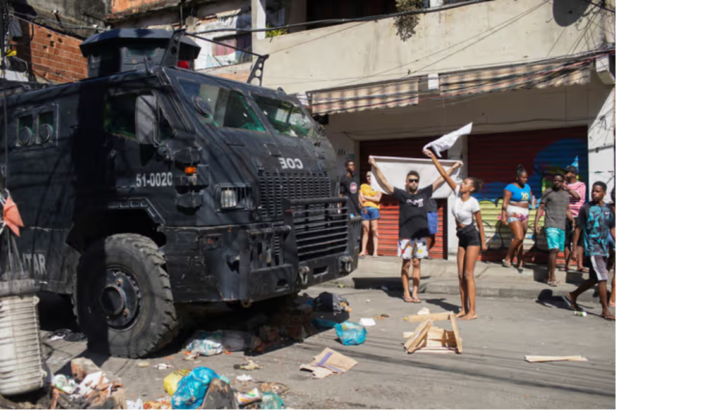
Latin America has recently witnessed an unprecedented public display of violence, seen, among other things, in direct military action by the United States in the Caribbean Sea and the Pacific Ocean, in the massive operation in two favelas in Rio de Janeiro, and in the inhumane treatment of people deported to the Terrorism Confinement Center (CECOT) in El Salvador. In this context, CELS, together with WOLA, Conectas, and Dejusticia, brought together a group of experts to reflect on militarization in the Americas and the role of this agenda in continental geopolitics.
International relations specialist Juan Gabriel Tokatlian pointed out that the current priority of US foreign policy is to reverse China’s expansion in the region and, to this end, Latin America is a strategic aspect. For this reason, the northern country’s National Security Strategy prioritizes the region with a heavy-handed and coercive approach. According to the specialist, the internal security of the United States is tied to continental security, and therefore they see the need for a selective deployment of specific actions in Latin America to regain the influence they had during the Cold War over the region’s military.
In addition, Tokatlian reflected on the worst diplomatic fragmentation in the last 50 years that our region is currently experiencing. Although the problems in Latin America are the same as those in the United States, there is no common agenda with mobilized social actors. Finally, he drew attention to the lack of reaction from the states in the region to the military attacks in the Caribbean and the silence of organizations such as the OAS.
Lisa Sánchez, director general of México Unido contra la Delincuencia (Mexico United Against Crime), described the deployment of the military for internal security tasks in several countries in the region and warned that we are facing a phenomenon of military empowerment that could have consequences for our democracies. One of the biggest problems they see is the lack of regulation and delimitation of the tasks assigned to the military, since their intervention is determined by presidential decrees or administrative resolutions. In addition, she highlighted that the Inter-American Court of Human Rights has stated that if there is military participation in security tasks, it must be subordinate, regulated, and subject to accountability mechanisms so that excessive use of force can be punished. However, she expressed concern about the possibility of finding alternatives to military intervention in a context where the security agenda has been instrumentalized for the negotiation of the economic agenda and political pressure from the United States on the rest of the region prevents the consolidation of critical voices on this phenomenon.
Manuel Tufró, director of the Justice and Security Area at CELS, analyzed the use of the concept of terrorism to justify the expansion of military interventions and the declaration of states of emergency that enable states to suspend procedural guarantees and increase the opacity of security operations. While anti-terrorism policies become normalized as completely opaque and allowing states to bypass guarantees, this approach begins to expand to include other things such as organized crime, but also political dissent, leading to a shrinking of civic space. In this way, governments go “in search of a problem” to frame it as terrorism. This trend can also be seen in the approach to migration from a security and criminalization perspective, which ends up feeding back into the elements of securitization and criminality. This is because closing regular migration routes opens the door to the creation of more illegal markets where the victims are the migrants themselves.
Glaucia Marinho, director of the Brazilian organization Justiça Global, addressed the differentiated impact of militarization policies on vulnerable populations, particularly young black people living in the favelas of Rio de Janeiro. She emphasized that military operations in the favelas, carried out under the pretext of combating drug trafficking, have deepened historical social and racial inequalities, while undermining human rights and public policies. In this regard, Marinho emphasized not only the psychological damage caused by a life of constant exposure to violence, but also the difficulties in pursuing accountability processes, since it is often the same forces that are responsible for investigating acts of violence. Regarding the operation carried out on October 30, which left 122 people dead, he mentioned that no expert analysis of the procedures has yet been carried out, so there will probably be no access to justice or reparations for the families affected.
Maureen Meyer, vice president of WOLA and moderator of the conversation, reflected on the importance of holding these debates in order to continue addressing this phenomenon. She also highlighted the important role that the different branches of government play in acting as “checks and balances” on the decisions of the executive branch.
The exchange showed that, although there are security problems in the region, countries continue to opt for “heavy-handed” approaches that increase violence. It is also clear that the deployment of these policies is being exacerbated by practices promoted by the United States, which is returning to interventionist approaches in the military, political, and economic spheres. The need to consolidate a regional strategy that challenges this model is becoming increasingly urgent.