
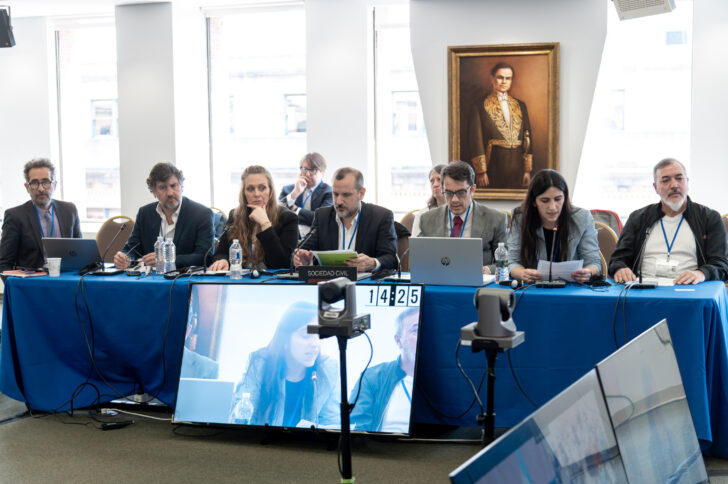
The National Association of Labor Judges (ANJUT), the Association of Labor Lawyers (AAL), the Latin American Association of Labor Lawyers (ALAAL), CELS, the United Trade Unions Front (FreSU), and the Buenos Aires Press Union (SiPreBA) participated in the hearing “Argentina: Legislative Impacts on Labor and Union Rights” during the 196th session of the Inter-American Commission on Human Rights (IACHR). We denounced the serious consequences that the labor reform and other measures promoted by the Argentine government have on workers’ rights, freedom of association, and access to justice.
We told the commissioners that these reforms are part of a process of setbacks that is incompatible with Argentina’s international obligations. Rodolfo Aguiar, general secretary of ATE Nacional, stated that “the approved labor reform amounts to the destruction of social rights in Argentina” and warned that, while the world debates the reduction of the workweek and the protection of labor on digital platforms, the country is moving in the opposite direction: working hours are being made more flexible, the principle of worker protection is being weakened, and employers are being exclusively favored.
Clara Chevalier, secretary general of CONADU, explained that the reform exacerbates a social crisis that particularly affects women. She noted that labor market flexibility and holding multiple jobs lead to a “poverty of time” that erodes collective organization and union activism, and has an asymmetrical impact based on gender. The lack of time creates a care crisis, disrupts family bonds, and multiplies tensions in households and communities. She also said that, after nearly three years in office, Argentina is undergoing a process that marginalizes broad sectors of society and asserted that Act 27,802 “is the legal manifestation of that trend: it undermines freedom of association, reduces collective bargaining to a residual form, and turns the right to assembly into a permit.”
Speaking on behalf of the National Association of Labor Judges (ANJUT), Juan Orsini warned that the elimination of the National Labor Court violates the right of access to a specialized jurisdiction recognized by the inter-American system. He argued that the reform violates judicial guarantees and judicial protection, since the work previously performed by 110 judges must now be carried out by only 43 of them, which jeopardizes effective judicial protection for workers.
On behalf of SiPreBA, Francisco Rabini denounced that the repeal of the Professional Journalists’ Statute leaves those who practice journalism without protection against corporations and political pressure. “A journalist in a precarious situation is a journalist who can be silenced,” he stated, warning that the fear of arbitrary dismissal acts as an indirect mechanism of censorship that undermines freedom of expression and society’s right to be informed.
Pablo Biró, general secretary of the Association of Airline Pilots (APLA), denounced the complete deregulation of the commercial aviation sector driven by Emergency Decree 70/23 and subsequent regulations, including those modifying crew duty and rest periods, which impact safety conditions. He also denounced restrictions on the right to strike and the political, personal and media persecution directed against APLA’s leadership.
Warnings from the IACHR
The members of the IACHR focused their remarks on the limits that international law imposes on labor reforms. The Commission’s president, Edgar Ralón Orellana, noted that the principle of progressivity does not prevent changes to legislation, but it does require preserving the essential content of rights: the issue is not whether a State can reform its laws, but whether those reforms objectively comply with inter-American standards. Along the same lines, Special Rapporteur Javier Palummo noted that States have some leeway to modernize their labor policies, but cautioned that such changes cannot be evaluated solely based on their effects on investment or employment, but must also be assessed in terms of their impact on human rights.
The questions directed at the government also focused on the process of drafting and implementing the reform. Commissioner José Luis Caballero Ochoa asked how the government engaged with labor unions during the legislative process and how it is fulfilling its obligation to bring domestic regulations into line with the American Convention through the conventionality review process, given that the IACHR itself has already ruled on various measures adopted by Argentina. The IACHR’s Executive Secretary Tania Reneaum Panszi questioned the lack of information regarding the deliberative process that led to the law, asked whether there was consensus among the sectors involved, and expressed doubt that reducing litigation was a valid reason for a reform of this magnitude. She also asked the State what the main goal of the reform was, and whether it was in fact aimed at improving the situation of workers.
We Call on the IACHR
As a representative of civil society, Mariana Amartino, vice president of the Association of Labor Lawyers, read the petition submitted to the Commission. We asked the IACHR to warn the Argentine State that the labor reform is incompatible with inter-American standards and to demand that it fulfill its human rights obligations; to declare that the repeal of the Statute of Professional Journalists is incompatible with the American Convention and to demand the restoration of guarantees for the free and safe exercise of the profession; that it request technical studies on the differential impact that the flexibilization of working hours and the extension of the probationary period have on women and the care economy; that it ensure respect for the right to a specialized labor jurisdiction; and that the Special Rapporteurship on Environmental, Economic, Social and Cultural rights conduct a visit to Argentina to assess the impact of the reform on workers’ rights in consultation with labor unions.
During the hearing, our organizations agreed that the changes promoted by the Argentine government do not represent a modernization of labor legislation; rather, they are part of a process that undermines freedom of association, restricts access to justice, makes working conditions more precarious, and disregards Inter-American standards.