
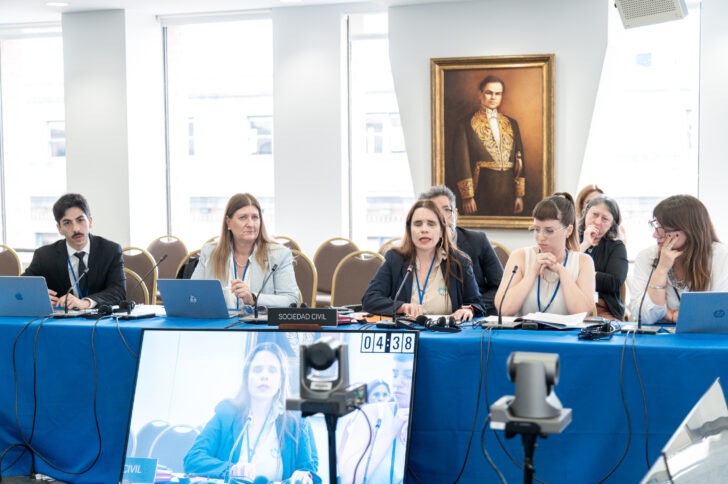
On August 3, the Inter-American Commission on Human Rights (IACHR) held a hearing on the impact of fiscal austerity on the right to health in Argentina, convened in response to a request submitted by CELS, ACIJ, REDI, Fundación Huésped, Fundación Soberanía Sanitaria, and Fundación Grupo Efecto Positivo. During the hearing, we presented data showing how the dismantling of public policies is affecting access to medications, vaccines, disability pensions, treatments for people living with HIV, mental health services, and long-term care—with particularly severe consequences for older adults, people with disabilities, children, and those living with chronic illnesses.
Commissioners expressed concern about the scope of the measures taken by the government and asked about the specific impact of the cuts, the assessments conducted regarding their consequences, and what steps were taken to prevent disruptions in essential treatments. They emphasized that the burden of public policy revisions should not fall on those who are already living in vulnerable situations.
The responses from government representatives confirmed the magnitude of the setback. The government reported that, as of June 2026, it had distributed just 17,300 first-aid kits through a new line that replaced the previous Remediar program. That figure, presented as an achievement, stands in stark contrast to the decline of a program that distributed approximately 162,000 first-aid kits in 2023 and 53,000 in 2025.
Similarly, the government highlighted that 1,553,000 people receive a public subsidy for essential medications, without mentioning that coverage had reached 4.6 million members before the cutbacks and that nearly 20 million fewer medications were sold in 2025. It also reported that 716,000 people have disability-related coverage through the Incluir Salud program, but failed to mention that since the beginning of the administration, only 8,633 new pensions have been granted, while more than 324,000 applications remain pending.
The situation for people living with HIV has also deteriorated. Some 140,000 people living with HIV reside in Argentina, and 13% are still unaware of their diagnosis. Over the past three years, the distribution of rapid tests has been cut in half, and at the time of the hearing, 18 medications used to treat HIV, tuberculosis, and hepatitis C were out of stock at the central level. This means that 62,000 people face the risk of interrupted treatment.
We also highlighted the decline in other health indicators. Childhood vaccination is proceeding at two different paces: while vaccination rates for the first year of life show some recovery, coverage for booster shots among 5-year-old girls and boys remains below 60 percent, when it should reach at least 95 percent to prevent outbreaks. This means that herd immunity could be lost. We also highlighted the underfunding of mental health policies and the cuts to benefits for people with disabilities resulting from non-payment and delayed payments.
We asked the IACHR to urge the Argentine government to halt measures that harm public health, restore the dismantled programs, and remedy the resulting harm. We also requested that the Special Rapporteur on Economic, Social, Cultural, and Environmental Rights prepare a specific report on the impact of fiscal austerity measures on the right to health and consider conducting a visit to the country.
ACIJ
CELS
REDI
Fundación Grupo Efecto Positivo
Fundación Huésped
Fundación Soberanía Sanitaria