
During the sessions of the 81st period of the United Nations General Assembly, Ben Saul, the Special Rapporteur on the promotion and protection of human rights and fundamental freedoms while countering terrorism, presented his report.
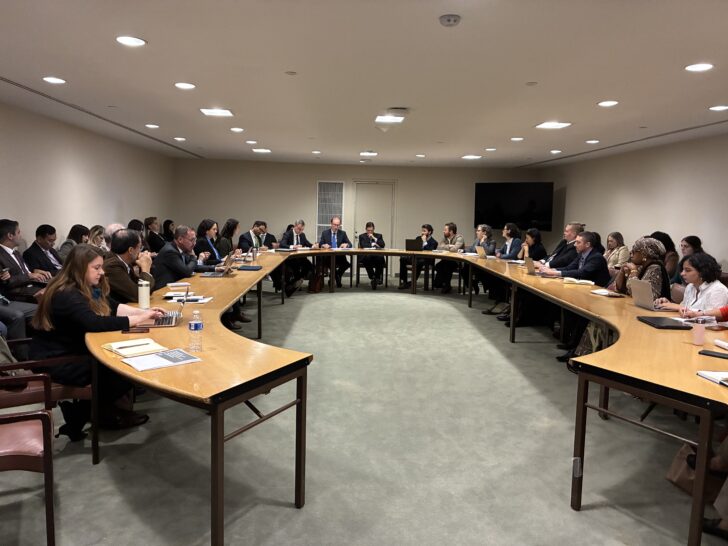
Together with him, and with the aim of reflecting on his conclusions and recommendations, we organized a side event on the margins of the 81st session in partnership with the American Civil Liberties Union (ACLU) and the Center for Constitutional Rights (CCR), which was attended by United Nations entities, civil society organizations, academics, and professionals.
Drawing on experiences in the Americas and comparative perspectives from other regions, we analyzed how states can effectively address the problem of organized crime and violence while, at the same time, preserving the essential distinction between terrorism and organized crime, safeguarding civic space, and ensuring full respect for international law.
CELS placed special emphasis on how counterterrorism and national security frameworks impact Latin America. We identified the abusive use of these frameworks in two main ways: first, as a justification for states of emergency and militarized security policies in the fight against organized crime; and second, as a political tool to expand state control, repress dissent, and dismantle democratic safeguards.
Trends in Countries Across the Region
Specifically, we highlighted five trends that Latin American countries are adopting to implement their authoritarian policies, fueled by the U.S. hemispheric agenda:
1. The expansion of counterterrorism frameworks is reshaping legal systems and state institutions throughout the region. Democratically elected governments are deploying these extraordinary tools under the pretext of combating “narco-terrorism.”
2. States are increasingly instrumentalizing counterterrorism to label peaceful protest as a destabilizing threat to security. By deploying mass surveillance, intelligence tools, and excessive criminal charges, governments create a severe “chilling effect” that reduces civic space in both the digital and physical spheres.
3. Beyond social protest, counterterrorism is directed against indigenous and peasant communities that oppose extractive industries and reclaim ancestral lands, as in the case of the Mapuche people.
4. Countries throughout the region are also implementing administrative sanctions lists. Operating under executive discretion and without judicial oversight, these mechanisms freeze assets and revoke legal status based on low standards of proof, violating due process.
5. Finally, reducing migration to a matter of national security has portrayed migrants as threats or facilitators of crime. This narrative enables mass deportations, prolonged detentions, and restrictions on access to asylum, while criminalizing solidarity organizations. Framing migration as a “foreign invasion” serves to justify collective expulsions and systemic rights violations.
In conclusion, we note that when national security and extraordinary measures become the permanent norm, their impact on fundamental rights ceases to depend on the political orientation of any particular administration. And in this environment, the “fourth pillar” of the UN’s counterterrorism architecture—respect for human rights—tends to disappear, even as a rhetorical stance. Therefore, until this architecture—which legitimizes extraordinary state powers—is directly challenged, the abuse of counterterrorism frameworks will continue to pose a permanent threat to democracy in Latin America and around the world.
Statements during 81st session of UNGA
.CELS Paper: Impact of the Counterterrorism and “National Security” Framework on Civic Spaces in Latin America.